
This blog post is being submitted as an assignment to Saranaz Barforoush as part of the University of British Columbia Master of Journalism course Media Ethics and Leadership.

Ancel Keys, a pioneering nutrition scientist, played a key role in making the high-carbohydrate, low-fat diet the basis of public health policy in the mid-20th century. The “policy” was chiefly symbolized by the Food Pyramid, now known as My Plate. Keys’ Seven Countries Study linked saturated fat intake to heart disease and shaped dietary guidelines worldwide.
Today, Keys faces criticism from journalists such as Gary Taubes, author of Good Calories, Bad Calories (2007), and Nina Teicholz, author of The Big Fat Surprise (2014). In documentaries like Fat: A Documentary (2019) and Fat Fiction: The Hidden Dangers of Low-Fat Diets (2021), as well as public media commentary and scientific publications, they argue that Keys selectively used data, showed bias in country selection, and downplayed sugar’s role in heart disease. Without the financial backing of certain industry associations and government endorsement, they say, Keys’ findings might not have gained such authority.
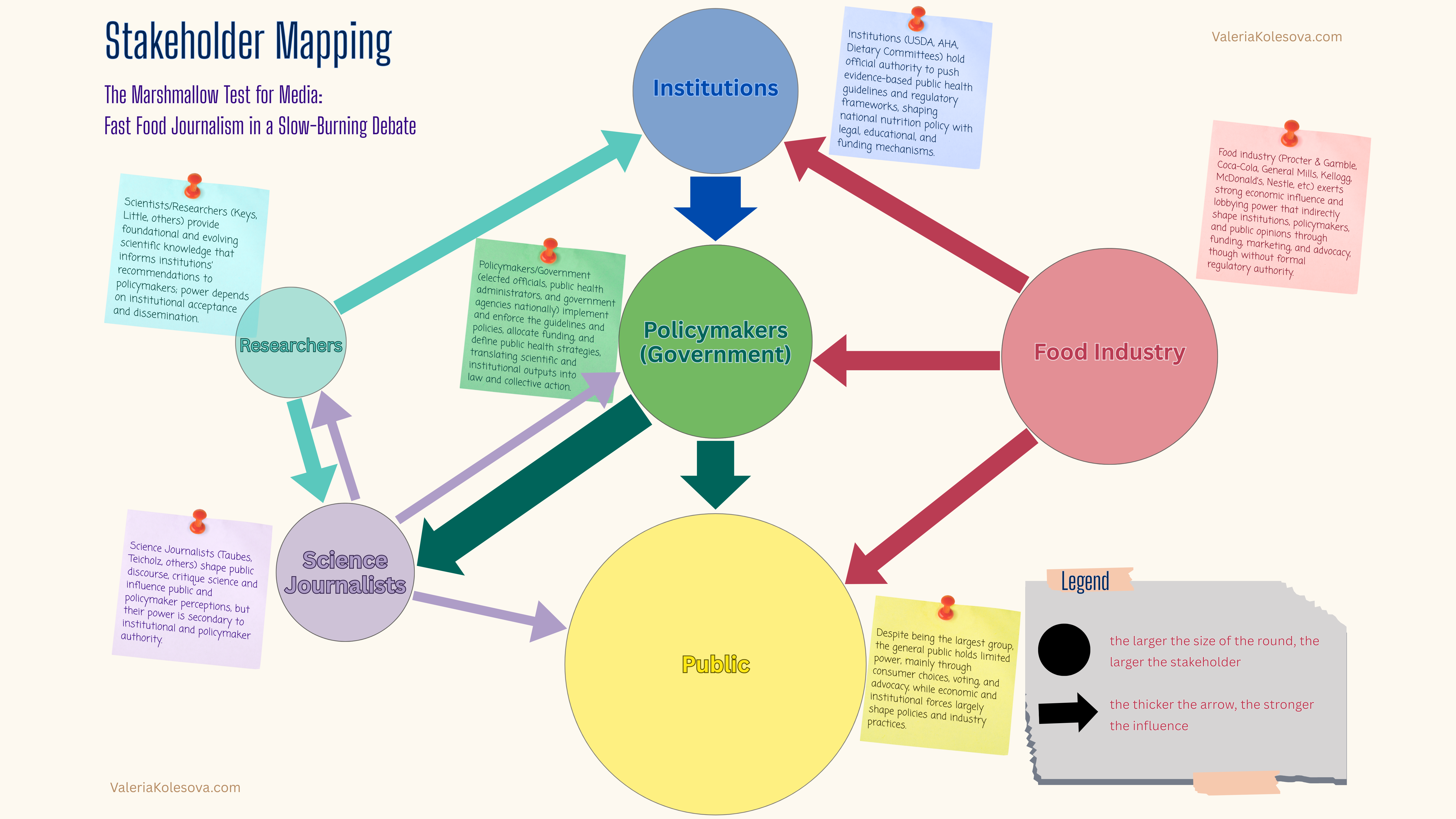
This ethical debate involves many stakeholders:
Scientists like Keys and Jonathan Little are the smallest stakeholder group, providing research that informs institutions; institutions such as the USDA and American Heart Association are medium-sized and highly influential, turning research into policy recommendations for government; government bodies, slightly larger and highly influential, approve and enforce these policies and influence journalists through access, agendas, and pressure; the food industry, the second largest, wields strong commercial and marketing influence over institutions, government, and the public; investigative journalists, a small group including Teicholz, Taubes, and myself, translate and challenge science and policies for the public; and finally, the general public, the largest group, who has minimal influence, mainly shaping outcomes through consumer behaviour, voting, and advocacy; and whose health is ultimately at stake.
I reviewed the original Seven Countries Study and found no major methodological flaws that warrant harsh criticism. To deepen my understanding, I consulted Dr. Jonathan Little, a professor at the University of British Columbia Okanagan’s Centre for Chronic Disease Prevention and Management. He specialises in metabolism, exercise physiology, and chronic disease. His view supports mine.
He said, “In short, I think some journalists conflate or overstate or overinterpret Ancel Keys as the culprit. When I read that paper, I see blood pressure, smoking, physical inactivity, and serum cholesterol all linked to heart disease deaths across cohorts, with regional differences. The data holds up well even today. I don’t see Keys making sweeping statements about fats or carbohydrates in the paper… It’s easy in hindsight to create a simplified narrative to blame someone/something but likely it isn’t that simple.”

In short, I think some journalists conflate or overstate or overinterpret Ancel Keys as the culprit.
Dr. Jonathan Little, Professor at the University of British Columbia Okanagan’s Centre for Chronic Disease Prevention and Management
Dr. Little’s response exposes a key issue: Many journalists fall into simplistic or reductionist framing and sensationalism. These are common traps in science reporting, where complex evidence is oversimplified into neat, attention-grabbing stories. This mistake relates to what social psychologists call oversimplification fallacy—when complex realities are boiled down to convenient stereotypes. Another common error journalists make is hindsight bias, which distorts past judgments once outcomes are known. This “knew-it-all-along” thinking was first identified by social psychologist Baruch Fischhoff in the 1970s.
To avoid these biases, social psychology and journalism lessons highlight the need for tolerance of uncertainty and delayed judgment. It parallels the famous Stanford marshmallow experiment, where children who delayed gratification achieved better outcomes. Similarly, journalists covering scientific controversies should resist rushing to quick conclusions or sensational headlines. Instead, they should wait for evidence to mature, especially on issues affecting millions.
Yet journalism’s demand for immediacy remains a challenge. Research shows that the current news cycle and public appetite for instant updates pressure journalists to publish fast, sometimes at the cost of nuance and accuracy. Despite this, responsible journalists can meet immediacy demands by clearly stating that knowledge is provisional, emphasising uncertainties, and sharing multiple expert views. This openness helps prevent oversimplification and hindsight bias, protecting both public understanding and journalistic credibility.
In conclusion, the Seven Countries Study controversy illustrates how journalistic framing biases and psychological tendencies might influence public opinion. Investigative journalism plays a vital role in questioning established science, but it must avoid reductionist framing, sensationalism, and hindsight bias. Embracing delayed gratification and nuanced reporting—even under time pressure—supports ethical journalism, respects scientific complexity, maintains trust, and safeguards public health.

Comments are closed